Where does one draw the line between the personal and the professional in the fieldwork context? Is the researcher self the same as the ‘normal’ self? And I write ‘normal’ in quotation marks because what is ‘normal’ and what is ‘not normal’ about the self? How much entanglements do we engage in as researchers between our personal lives and the professional lives through which we conduct our research? Yes, I have written before about the importance of researcher reflexivity in the fieldwork encounter. That was about the thin line between and negotiating the ‘outsider’ vs. ‘insider’ positionality. Yet, the conundrum I faced during my recon fieldwork in Namibia has been of a slightly different kind. Here, I was clearly an ‘outsider’ even if people mistook me to be a Namibian. What I experienced was perhaps a bit more a phenomenological kind. One where the personal become the field and the field become the personal. In order words it felt at some points that I was researching my own self within the field and the field was somehow also researching into me. Gaining clarity in the field also gave me clarity to my own self. There was this co-constitutive nature of gaining insights into my own self and gaining insights into the field. An open-ended proces of becoming. I was becoming the field and the field was becoming me. Okay, you are talking too much theory here Emmanuel. Give us some empirics. Sure, let’s start from here:
After my visit to the Swakopmund Genocide Museum (SGM), it was time to go and see the site of the unmarked Herero graves – the Swakopmund Memorial Park Cemetery (SMPC). I had read some description of this place prior to coming to Namibia and Laidlaw at the SGM had also talked about it during my visit. I thought I will go, check out the memorial, make some pictures and continue to the Swakopmund Museum at the seaside. But I was not quite prepared for the encounter. The SMPC is quite a large area with three distinct sections – the nicely manicured German part, the Jewish part and the unmarked Herero part of shifting sand mounds. At the point where these three cemeteries come together is a cross.
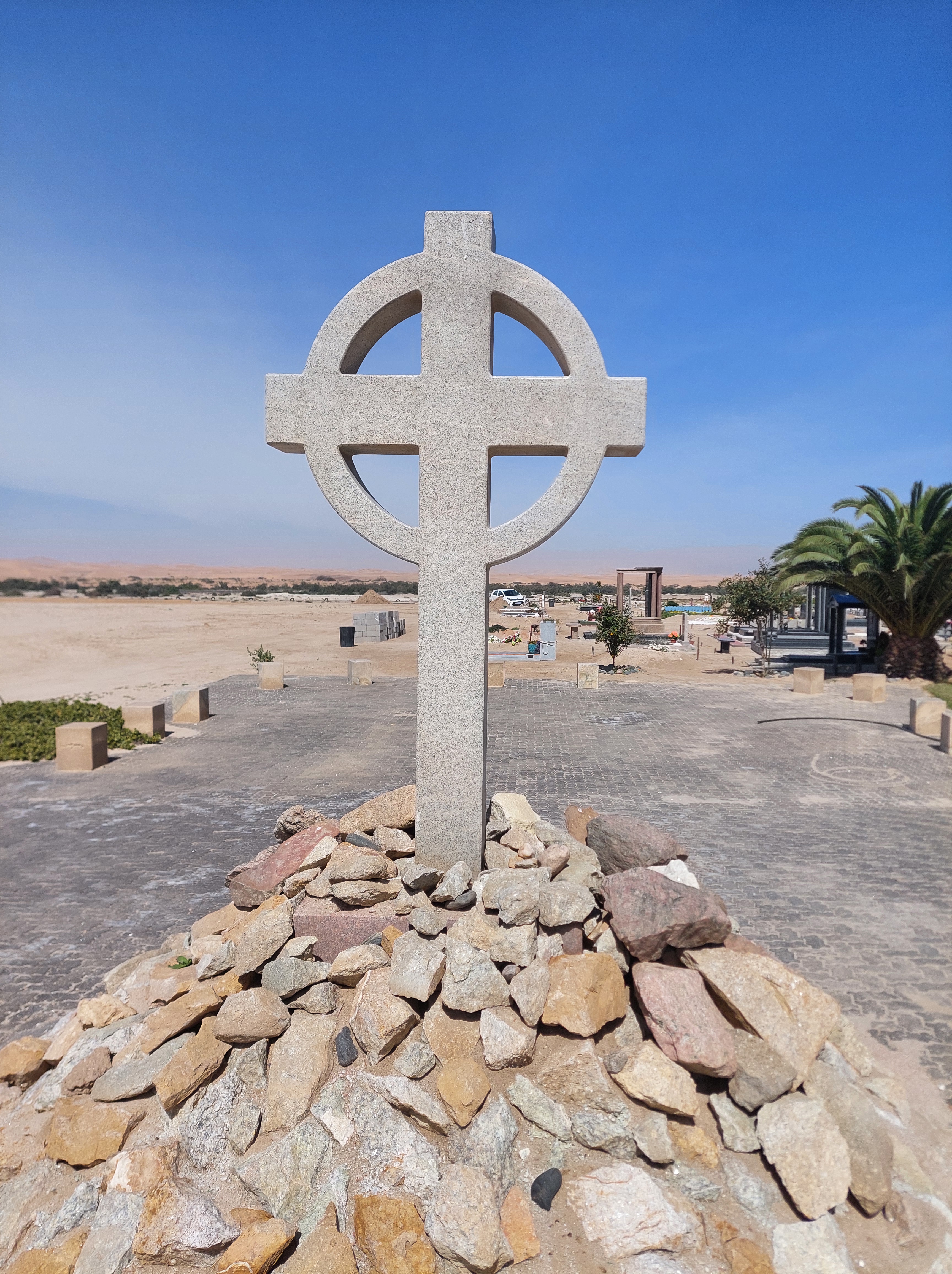
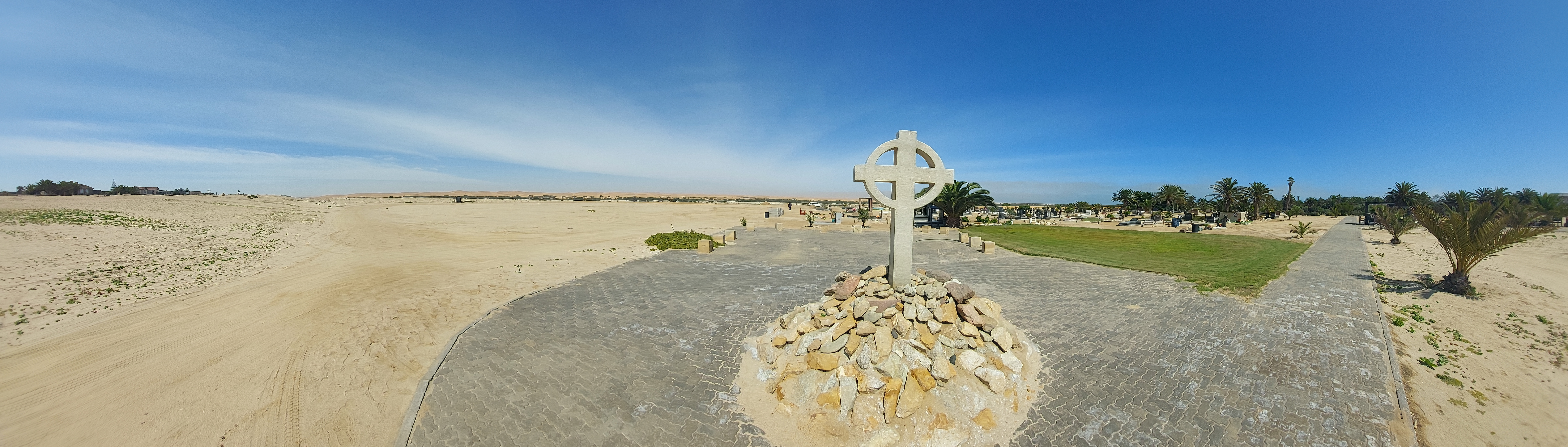
As it turned out, I ended up entering the walled cemetery through a gate that lead me to this intersection. Walking towards the cross, I thought I will pause in front of it and have a minute of contemplative silence in respect and honour of those buried there. I also thought I would recall and honour people I know who have passed away. Then it hit me! Bam! Just like that! Right in my inner guts! Emotively! Viscerally! My mum! My own dear mother who passed away in 2022. It was her thoughts that hit me standing there in a cemetery in Swakopmund, Namibia. Then it hit me further. This was the first time I was at a cemetery since my mum’s burial. The pause took longer than the 1 minute I had envisaged. My heart and mind swelled and the sensation of sadness flowed through my body. I had this sudden mix of sadness at the thought of my mum and a sense of shared sadness with the descendants of the Herero who come here to unmarked graves to remember. How do you grieve when your loved ones who have passed are not accorded the dignity of a proper burial? In the context of my own experience and standing there in the field, I thought I caught a glimpse of some insights into my research and also of my own self in relation to how I think of my mother’s passing.
The other empirical example is what I have often considered an issue of ‘wasted’ fieldwork data. I still have the stuck of completed questionnaires, interview recordings and observational notes from my first master’s thesis in 2010. Every now and then I caught myself thinking I didn’t fully utilize the date and that I could and should go back to analyze it again. The same counts for the fieldwork for my other master thesis, that of my PhD fieldwork and most recently of the vast amount of data from my just ended NWO Veni project. I wrestle with this thought of ‘waste’ . But this Namibia recon trip has shown me that it’s actually not a ‘waste’. All my previous fieldwork experiences and data (whether I fully published from them or not) has provided me the foundation of being a better researcher – able to quickly establish rapport, ask better questions, think more broadly and write more deeply. Hopefully this translate also into better supervision for my PhD candidates coming to the FRICTIONS project. I realized that my not rushing with publications but sitting with data for longer, my ideas mature and develop better. Thus while I didn’t publish copiously out of my Veni project, I find the few pieces I did to be richer. Letting the ideas simmer with me was also key foundation for me in developing my thoughts further through new conceptualization. It was building on this vastness of ‘wasted’ fieldwork data and experience that enable me to land this ERC Starting Grant for the FRICTIONS project. So now I look back with gratitude on all my past fieldwork experiences instead of with the sense of ‘wasted’ data.

Now let me bring this together somewhat. Here goes more rumblings of unfiltered thoughts. Since my marriage ended in divorce, I have often struggled with this sense of failure (still does every now and then although increasingly less so) and even a feeling of wasted years. Of dreams shattered. Of an imagined future come undone. Of deep sadness. Similarly, I realised that since my mum passed away, I have often thought of her passing only in the sense of the deep sadness I feel. Of dreams shattered. Of an imagined future come undone as we had plans of her coming to visit me in Europe and I had so many great ideas of showing her around. To share experiences together. To see her being amazed, intrigued and amused by some of the things and ways of life on this side of the world. But alas, from the twice UK visa denial when I wanted her to come to my PhD graduation and then to COVID-19 interruption, it just didn’t happen before she passed away. But now these two events have taken on newer meanings for me. As a result of being in the field, through the encounters with people, places and moments, through thinking and reflecting and through a series of turns of events and serendipity, I’ve gained a keener, deeper, nuanced sense of self and a fuller perspective of these relatively recent two life defining shaping moments of my life – my divorce and my mum passing away.
Some might say this was just a natural grieving process that was bound to come to an end somehow, somewhere, somewhen. Certainly I had been processing these events over the years and maybe I was coming to the end of the grieving process – or maybe not. I am not sure as those are just counterfactuals. What I do know is this. There is a “suddenness” to the ‘final’ resolutions that has occurred to me and in me across the 8 days of fieldwork. It’s almost as if a switch was suddenly and decisively switched on/off. Like the scales fell off the eyes of my mind. Like the ‘coin just dropped’. Like I found the last piece of the jigsaw that made it complete. A clarity in the mirage. That slight twitch of the eye to see a detail in a picture come suddenly alive. That to me is now to look back with great big gratitude on my mum’s life – the life she gave me, the life we shared, the values she taught me, beat into instilled in me, her humor and mischief, the jokes we shared between only us, and the pride I saw in her eyes when I first graduated from the university with my BA. To think of how her life has afforded me the life I have now and to continue to do my best to make her proud.
In similar vein, I realized that I have been thinking of my divorce all wrong for far too long. The epiphany came to me on the long bus ride from Windhoek to Swakopmund. As the impressive landscape rolled by as a background to my thinking thoughts and reflective reflections, I arrived to the epiphany. One that I struggled to hold on to in the past because there was an incongruence between the thoughts and the everyday lived feelings. But on that bus ride, the congruence became embodied and whole. My marriage has ended, sure. It sucked, sure, Dreams shattered, sure. But it has also been a wonderful gift that has given me so much. I could think back with gratitude of all that it was and has been (now without the overwhelming sadness and sense of failure). Of the blessings that came out of it. Of the joys, tears, ups, downs and in-between. Of how it’s made me who I am now. Of the things that came out of it that now provides a foundation for a new future. Of the chance for me to dream again. Of a new season of life to be lived thanks to the life I once lived.
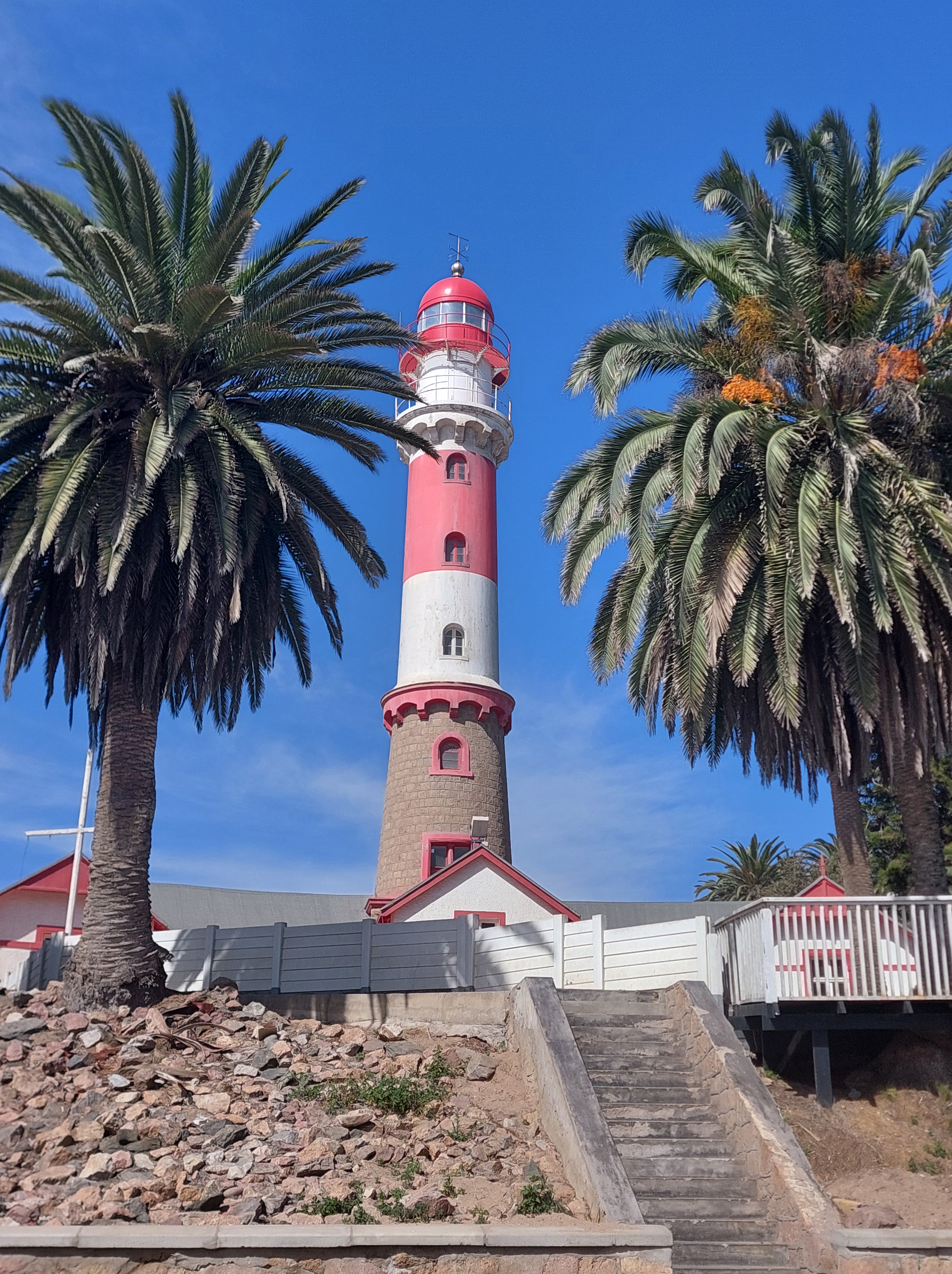


Now this is how the field become personal and the personal became the field. The intertwining of knowing the field and knowing one’s self. This short recon fieldwork visit to Namibia has given me more than I could have foreseen. I’m grateful for where I have been, where I am and where I am going amidst the co-constituting and becoming of my professional researcher self with the FRICTIONS project and of my personal self with the many wonderful aspects of life yet to be lived. Whew! This ended up being a long post. Thank you for reading up to this point. I would love to hear your thoughts on all my rumblings.
 Emmanuel Akwasi Adu-Ampong