Welcome and thank you for joining me on this adventure. For the newbies, you can catch up on previous posts: first blog post, second blog post here, third blog post here, fourth blog post here, fifth post here, sixth post here, seventh post here, eighth post here, the ninth post here, tenth post here, eleventh post here, twelfth post here and thirteenth post
Tick tock, tick tock, tick tock…so goes the clock as it keeps ticking along whether one notices it or not. And so it came to pass that this week on Thursday 9 April, 14.00 CET was the due date for the NWO Vidi proposal. This week’s goal was simple and straightforward: do all it takes to get the proposal ready and submit it on time. I will not bore you with all the details about how I got there but what is important to note is that I did manage to finalise the proposal and submit it on time with a couple of hours to spare.

For now I just want to say a big thank you to everyone who has been part of this journey – in big and small ways including those who took time to read the weekly update. It really takes a whole village to raise a proposal from a seed of an idea into a fully-fledged grant proposal. I’m going to take the next couple of days to catch my breath and then I will be back with some further reflections on this journey.
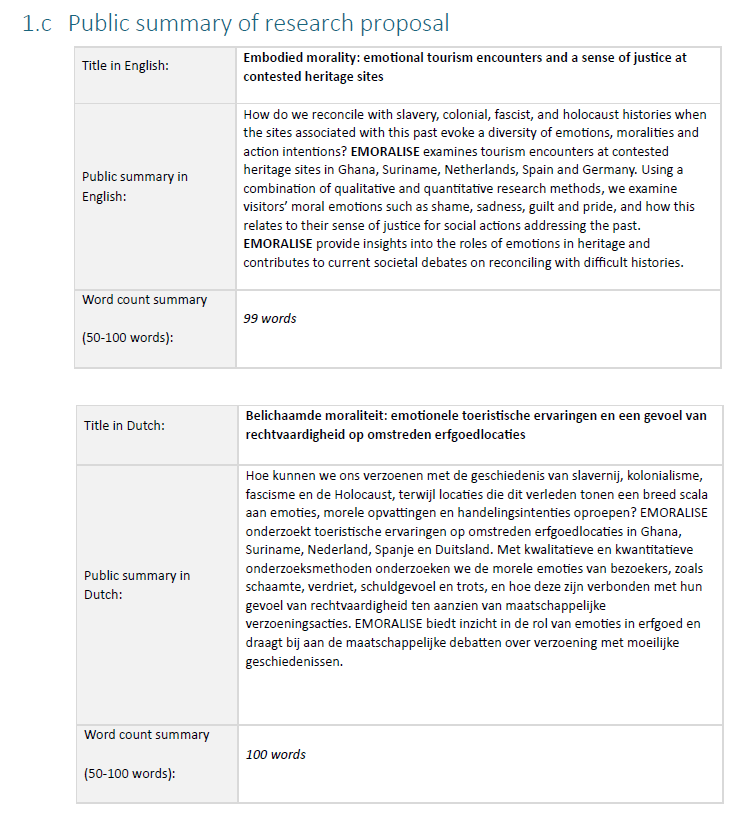
I can now outdoor the final title of the proposal and the scientific summary as submitted. I’m also adding screenshots of the public summaries:
(EMORALISE) Embodied morality: emotional tourism encounters and a sense of justice at contested heritage sites
Reconciling with slavery, colonial, fascist, and holocaust histories is an ongoing social process evoking a diversity of emotions, moralities and action-intentions. Current societal tensions over these pasts call for deeper scientific understanding. The places commemorating these pasts are often curated through tourism encounters. In the context ofongoing processes of finding morally appropriate and just ways to reconcile with the past, examining tourism encounters and dynamic tensions between visitors provides an understanding of larger societal debates, as heritage sites evoke moral emotions such as shame, sadness, guilt and pride. Moreover, policy actors call for ‘decolonizing’ contested heritage through exploring divergent emotions in heritage making. Yet, emotions and their roles in heritage practices and the negotiation of moral principles remain understudied in tourism, heritage and museum studies.
EMORALISE aims to investigate the ways emotions come to matter in tourism encounters at contested heritage sites, for whom and for which moral attitudes toward reconciling with the past. The conceptual notion of embodied moral emotions is proposed as a novel framework for an interdisciplinary, grounded and rigorous test of relationships between the emotions evoked at contested heritage sites and the moral attitudes towards justice-making.
This project uses an ambitious mixed-method theory-building and theory-testing approach combining qualitative case studies with quantitative correlational and quasi-experimental designs. This approach brings into simultaneous conversation contested heritage sites in Ghana (Elmina Castle); Suriname (Fort Zeelandia); Netherlands (Black Heritage Amsterdam Tours and, Westerbork Remembrance Centre); Germany (Dachau Concentration Camp Memorial Site) and; Spain (Cuelgamuros Valley). Applying comparative qualitative coding and multi-level structural equation modelling, the analysis remain sensitive to discriminating individual, contextual and generic factors, allowing nuanced understanding of commonalities and differences.
EMORALISE will contribute to scientific understanding of roles of emotions and ethics in heritage and to public debates on justice-making measures needed to reconcile with historical atrocities.
The adventure continues…see you next time for the another instalment of the #NWOVididiaries blog post.
 Emmanuel Akwasi Adu-Ampong