I feel at once ecstatic, jubilant and humbled with a keen sense of my extreme privilege in being awarded the Dutch National Research Council (NWO) Veni grant – being 1 of 162 laurates awarded out of 1,127 applicants. This has been more than a year in the process of thinking and writing long before the first pre-proposal submission in September, 2019 through to the full submission in January, 2020 followed by reviews, rebuttals and interview. I will write about this whole process in a future blog next week or so after it all sinks in.
To see what privilege it is to win this award and the fine margins involved in being successful or otherwise, consider these statistics from the NWO.
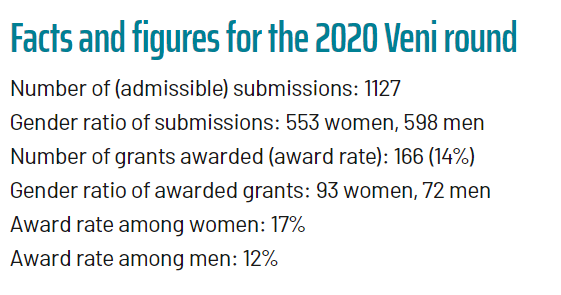
…14% success rate is pretty grim. So I say good luck for the future research ideas and commiserations to those other 961 excellent early career researchers not granted. It is on some levels simply insane how the current process works – also a subject for another day.
For now I just want to share this exciting news of having my project funded for €250,000 over 3 years. I am so grateful to so many people who have stood along with me through this application process – from my lovely wife Marre and kids who’ve provide the inspiration to keep going, to my Surinamese friend Vinije Haabo, to my colleagues at the Cultural Geography Chair Group at Wageningen University who’ve had to read drafts and drafts of the proposal and external friends and colleagues (too numerous to name here) who have provide comments, suggestions, feedback and moral support. Thank you!
The title and abstract of the project as submitted is below:
Title of the research proposal
The Embodied Absence of the Past: Slavery, Heritage and Tourism in the Ghana-Suriname-Netherlands Triangle
Scientific summary of research proposal
In an increasingly diverse society, the stories we tell about the past can bring us together or pull us apart. In the Netherlands, people of African descent embody a given past. Yet, the stories of slavery, colonialization and racism are often absent because they are considered as potentially contentious. This is the notion of the embodied absence of the past, exemplified for instance by the yearly polarising debates on Keti Koti and Zwarte Piet. This project focuses on how tourism transforms and narrates the past of slavery, specifically that between Ghana, Suriname and the Netherlands stemming from the Trans-Atlantic Slave Trade. The main question is: Which narratives emerge from the transformation of the shared slavery-related historical sites in Ghana, Suriname and the Netherlands into heritage tourism places?
Innovatively combining insights from cultural geography, tourism studies and heritage studies, this research develops the conceptual notion of the embodied absence of the past to examine how such transformations stimulate plural public memories and engagements that challenge established narratives about the past, identity and belonging. The empirical focus lies on Ghana (Elmina Castle and Fort Amsterdam), Suriname (Fort Zeelandia and Frederiksdorp Plantation) and the Netherlands (National Slavery Monument and Black Heritage Tours Amsterdam).
Underlined by an interpretive phenomenological approach, this research combines qualitative ethnographic methods – participant observation, interviewing, visual and document analysis – for data collection and analysis. The study highlights tourism’s transformative role in raising awareness of slavery heritage and informs policy debates on how to deal with places of remembrance in contemporary society. These are key pillars of the “Living History” thematic route of the Dutch National Research Agenda. In our diverse society, the more we tell the stories of the past, the more united we become and the better we can tackle present challenges such as polarisation, racism and discrimination.
You can also listen to me outline the focus of this project in this Black History (Achievement) Month lecture I gave last month.
 Emmanuel Akwasi Adu-Ampong
Pingback: Manscript rejected after reviews…boo! | Emmanuel Akwasi Adu-Ampong
Pingback: Slavery Heritage Tourism: places of remembrance and spaces of dialogue – a Studium Generale Lecture | Emmanuel Akwasi Adu-Ampong
Pingback: Veni project is starting today: Slavery, Heritage and Tourism in the Ghana-Suriname-Netherlands Triangle | Emmanuel Akwasi Adu-Ampong
Pingback: Lift every voice and sing: sound, emotion and affect in the fieldwork encounter | Emmanuel Akwasi Adu-Ampong
Pingback: Premiere of Veni research project edumentary video | Emmanuel Akwasi Adu-Ampong
Pingback: “Tourism, Memory and Heritage” Conference, 1 – 2 June 2023 in Amsterdam (Save the date annoucement II) | Emmanuel Akwasi Adu-Ampong
Pingback: [Publication (video) ALERT!] A visual explainer of the embodied absence of the past | Emmanuel Akwasi Adu-Ampong
Pingback: [New paper, Open Access] Commemoration and commodification: slavery heritage, Black travel and the #YearofReturn2019 in Ghana | Emmanuel Akwasi Adu-Ampong
Pingback: Wageningen: my guided walking tour of the traces of the slavery and colonial past | Emmanuel Akwasi Adu-Ampong
Pingback: [New paper, Open Access] The spatial narratives and representation of slavery and colonial heritage on guided tours in Amsterdam | Emmanuel Akwasi Adu-Ampong
Pingback: I have an ERC Starting Grant! 5-year research project funded! | Emmanuel Akwasi Adu-Ampong
Pingback: The Calabash Onder de Bigi Bon (Save the date!) | Emmanuel Akwasi Adu-Ampong
Pingback: Documentary Film Premiere (06.12.24): The Embodied Absence of the Past | Emmanuel Akwasi Adu-Ampong
Pingback: December to Remember: Afehyia Pa ooo | Emmanuel Akwasi Adu-Ampong
Pingback: FRICTIONS starts today!: lift-off time for my ERC Starting Grant project (Frictions of space: the generative tensions of slavery and colonial heritage tourism) | Emmanuel Akwasi Adu-Ampong
Pingback: [New book chapter published!] Making an Embodied Absence Present: Tourism and the Culturla Imaginary of Slavery and Colonial Heritage in the Netherlands | Emmanuel Akwasi Adu-Ampong
Pingback: The slow hard work of societal impact I: on needles and threads. | Emmanuel Akwasi Adu-Ampong
Pingback: “I came, but can I see?”: The NWO Vidi grant application journey (#NWOVidi2025diaries) | Emmanuel Akwasi Adu-Ampong