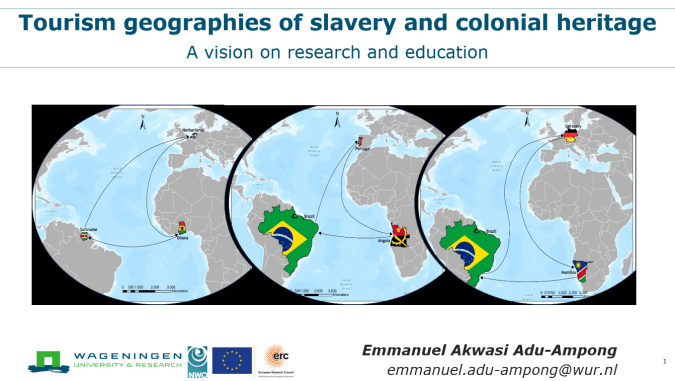
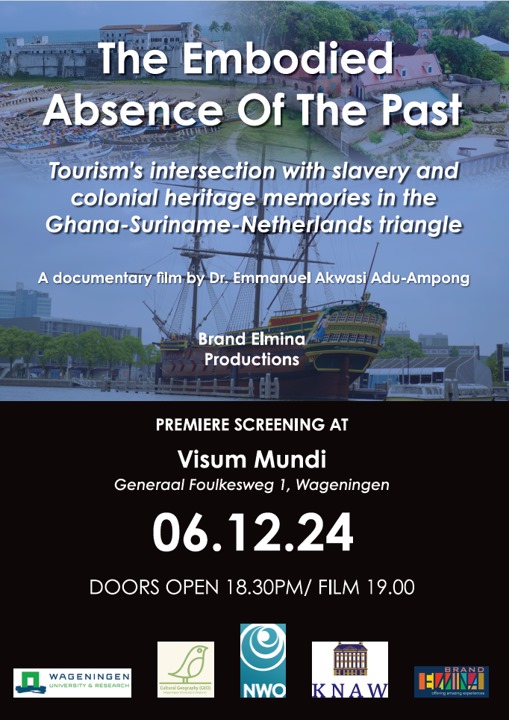
The completion of my NWO Veni project calls for a celebration, marking the end of my research journey through Ghana, Suriname, and the Netherlands. In 11 weeks, I will host a commemorative event titled "The Calabash Onder de Bigi Bon," inspired by Dr. Afua Twum-Danso Imoh, who previously organized an event called "The Calabash." This gathering will feature a screening of the film (edumentary) I created based on my project. The event is scheduled for December 6, 2024, in Wageningen, and registration details will be provided soon.
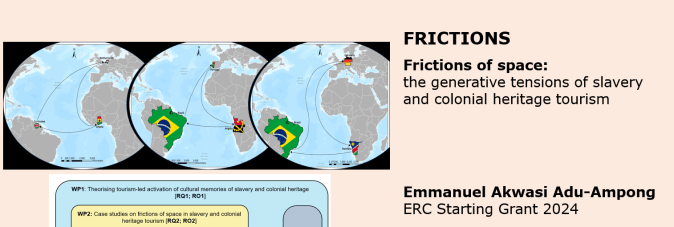
I have an ERC Starting Grant! 5-year research project funded!
The author is ecstatic about being awarded a European Research Council Starting Grant for a 5-year research project, expressing gratitude to God and colleagues. The project, FRICTIONS, focuses on how tourism impacts slavery and colonial heritage, aiming to shift societal narratives. The author plans to recruit 3 PhD candidates and a Postdoc to join the research team. Despite the challenges during the application process, the author encourages unsuccessful applicants and acknowledges their efforts. The post also hints at upcoming vacancies and promises more details about the project. The author concludes by congratulating other grant awardees and wishing good luck to those who were not successful.
[New paper, Open Access] The spatial narratives and representation of slavery and colonial heritage on guided tours in Amsterdam
This paper discusses the representation of slavery and colonial heritage on guided tours in Amsterdam, focusing on the spatial narratives used by tour guides and the factors shaping these narratives. The research highlights the influence of creating a positive atmosphere in engaging tourists with these sensitive topics. Additionally, the study provides a spatial mapping of the specific geographic sites in Amsterdam where slavery and colonial heritage narratives are told. The paper aims to showcase the transformative potential of tourism and tour guides in addressing slavery and heritage in a European urban setting.
Peruvian Posts IV: Machu Picchu
The final part of the Peruvian adventure details a four-day mountain hike culminating in Machu Picchu, a site of Inca ruins. The experience is described as both a climax and an anti-climax due to the overwhelming crowds upon arrival. The author recommends the Classic 4 Days/3 Nights Inca Trail Hike with a local tour operator and reflects on the formation of strong friendships within the hiking group. The journey itself is highlighted, with challenges faced at high altitudes, and the beauty of the natural surroundings is deeply appreciated.
Peruvian Posts III: Cusco as an imagined destination vs. Cusco as a lived destination
Cusco, once the capital of the Inca Empire, offered a glimpse of both its grandeur and the impact of Spanish colonization. The high altitude and chilly weather required acclimatization and I observed the combination of tourism products and experiences, Cusco's place in a network of destinations, and the intermingling of lived and imagined aspects of the city. Amidst staged tourist experiences, I encountered a large number of domestic tourists and noticed the influence of Moorish architectural style. My next adventure was the epic Inca Trail trek to Machu Picchu.
Peruvian Posts II: the missed flight and an unending unfolding airport drama lost in’Spanglish’ translation
After attending the Memory Studies Association conference in Lima, a series of stressful and dramatic events unfolded. Missing the flight to Cusco was only the beginning, followed by a struggle to retrieve luggage and a scare about a lost backpack. However, all's well that ends well, as the backpack was found on the plane. Despite the challenges, the experience in Cusco proved to be worth it, albeit with some struggles adjusting to the high altitude and cold weather. Stay tuned for more Peruvian adventures.
Peruvian Posts I: Lima and the Memory Studies Association 2024 Conference
Increasingly, I have come to describe 'niche out' my research work as being focused on the geographies of slavery and colonial heritage tourism in relation to the politics of cultural memory. This niching out process required my search for more (trans-inter) disciplinary grounding for my research. It is in this light that I arrived at … Continue reading Peruvian Posts I: Lima and the Memory Studies Association 2024 Conference
[New paper, Open Access] In the potter’s hand: tourism and the everyday practices of authentic intangible cultural heritage in a pottery village
Pottery holds enduring significance in human history. Reshaping Eleanor White's thesis into an academic article was a gratifying process. Exploring the pottery village of Margarites, Crete, the paper delves into authenticity in the context of tourism and intangible cultural heritage. It illuminates the impact of tourism on the community's perception of authenticity in ceramic crafting.
Wageningen: my guided walking tour of the traces of the slavery and colonial past
It is one thing to dream about it, one thing to get funding to research about it, one thing to teach about it and surely one thing to actually be the one to do it. This was a fully embodied experience for me. How could I have seen it when I first set out my … Continue reading Wageningen: my guided walking tour of the traces of the slavery and colonial past
Commemorating Keti Koti in Wageningen
For the third year running, there was a Keti Koti commemorative ceremony in Wageningen. I had missed the first two occasions because of my research fieldwork in Suriname in 2022 and research fieldwork in Amsterdam in 2023. Fortunately, I was able to stay local this year. Thus on Sunday 30 June 2024, I joined a … Continue reading Commemorating Keti Koti in Wageningen