This latest paper is thanks to the hardwork of Simone Berg my former thesis student who carried our her MSc thesis work on my Veni project. Given the careful attention we paid to setting up her thesis project we knew that the findings would be worth reporting to a larger audience. It was therefore a delightful process for us to reshape the MSc thesis into an academic article. Thankfully, the whole process went relatively smoothly including dealing with the constructive comments from reviewers. We are therefore delighted into to see this manuscript publised in the Journal of Heritage Tourism. In this paper we explore how tour guides navigate around the increasing societal discussion on slavery and colonial heritage on their guided tours in Amsterdam. How much of the societal discussions get pulled into tour guides’ spatial narratives and what are the key factors that shape the extent to which tour guides are willing to talk about slavery and colonial heritage narratives? We found that the need for positive atmosphere and good vibes are central to the extent to which tour guides are willing to engage tourists with slavery and colonial narratives in the city. We also offer a spatial mapping of which slavery and colonial heritage narratives are told at which specific geographic sites in Amsterdam.
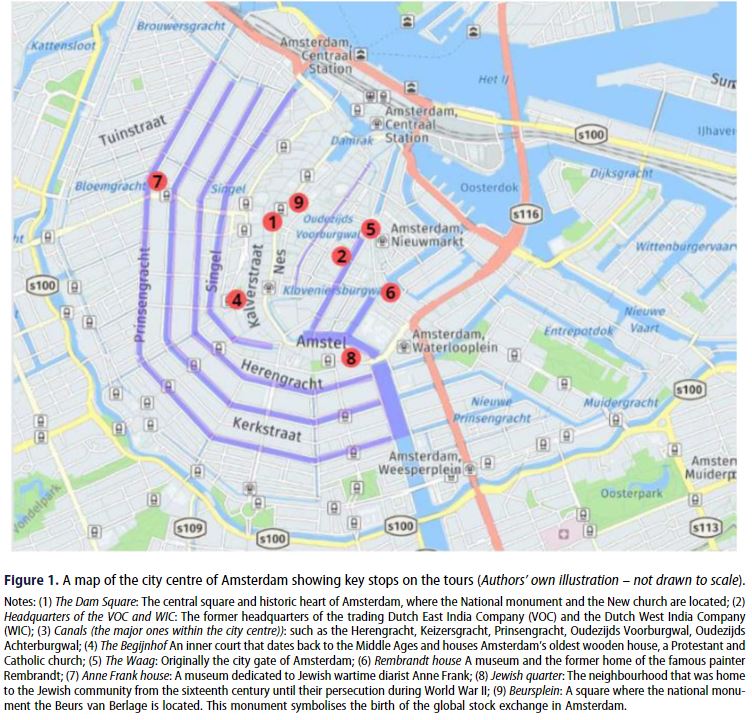
Certainly, our map could have been a bit more hi-tech. We are happy to get contacts of map-savvy readers who would like to help us make it better. Please reach out to us
The paper is published as open access – free to read, free to download, free to cite and free to use in your teaching 🙂 You can download a copy below.
Title:
The spatial narratives and representation of slavery and colonial heritage on guided tours in Amsterdam
Abstract
Amidst increasing societal discussion on slavery and colonial heritage, tourism has emerged as a potential avenue to address such concerns. Yet, tourism and tour guiding suffers from a paradox. On the one hand, tourism narratives can form a part of an oppressive strategy in colonial approaches against socially excluded and marginalised groups while on the other hand, tourism can offer counter-narratives with progressive potential in transforming mindsets and enlarging perspectives. This article explores these conceptual issues in the context of guided city tours in Amsterdam utilising a qualitative case study design involving participant observation and interviews. We identify the spatial narratives tour guides use to (re)present slavery and colonial heritage, and the factors shaping these narratives. We make two main contributions to the literature. Firstly, we identify how the need for positive atmosphere and good vibes are central to the extent to which tour guides are willing to engage tourists with slavery and colonial narratives in the city. Secondly, we offer a spatial mapping of slavery and colonial heritage narratives offered on tours through Amsterdam. Our study therefore contributes to evidencing how tourism, and tour guides hold transformative potential in dealing with slavery and heritage in an European urban setting.
https://www.tandfonline.com/doi/epdf/10.1080/1743873X.2024.2382483?
 Emmanuel Akwasi Adu-Ampong