I had a rather early start for Day 4 of fieldwork. I was beginning to feel the intensity from the preceeding days of participant observation, interviews and conversations. I wished I could chill in bed for a while longer but that was not an option. My plan of attending an Easter Sunday Church service in the afternoon at the Freedom City Church had already gone out of the window due to a reshuffling of an appointment to the late afternoon.

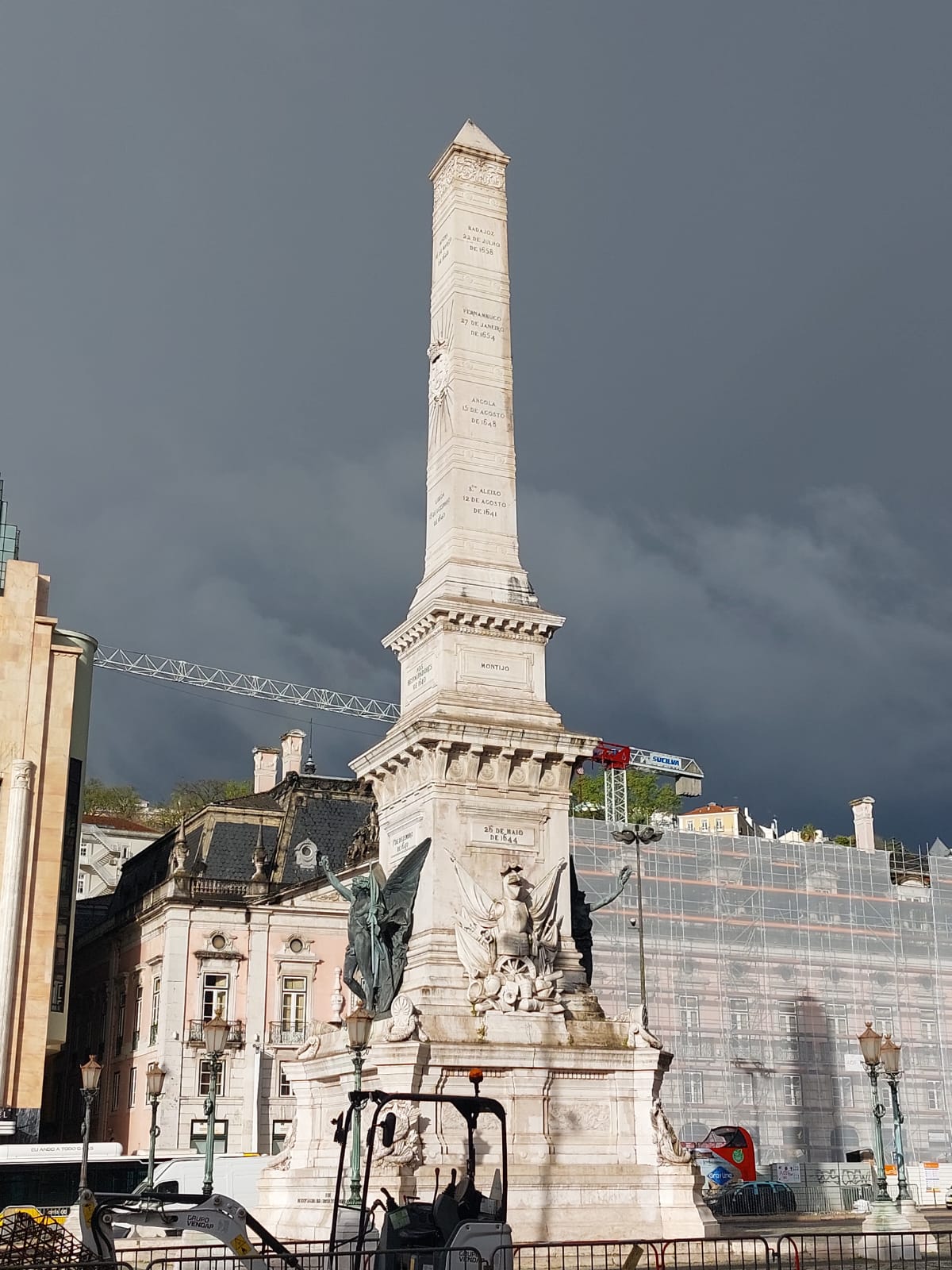
Begrudgingly I made my way to Praça dos Restauradores for the 09.00am start. The rains had been doing it’s thing of on-and-off, start-and-stop action so I was curious to see how it pans out. It turned out the Alcides – the tour guide who set up the Lisbon African Presence Walking Tour – had actually reset the start time to 10.00am (due to the ‘clock going forward’). He had actually typed up the message of this change in Whatsapp but forget to press send to me. Ah well, all is well that ends well. He did show up at 09.00 so the upside of it had the chance to then have the interview with him before the tour began. Sadly, there were cancellations due to sickness and also the heavy rain the descended around 09.20am. It was a very insightful interview as I learned among other things the ups and downs of running a tour business (exemplified by sudden cancellations we experienced in the morning). Fortunately, I got a private tour with Alcides who showed me the key highlights of the regular tour. I got to learn of all the various lifts and escalators scattered around the hilly city of Lisbon to enable ease of mobility from one side to the other. I did wonder if my old city of Sheffield with all it’s hill could consider something like this.
In the afternoon, Djuzé from the organisation Batoto Yetu came to pick me up for the ‘Discovering Lisbon’s African Heritage‘ guided tour. This was a tour and interview rolled into one and we spent close to 4 hours. I got to visit neighbourhoods outside of the central city district where the majority of the people of African descent live. I learnt about the history of these neighbourhoods, their ongoign transformation and how they speak to enduring shared history and heritage between African and Portugal. We went to see the ‘Monument to the African Worker’ that commemorates the contribution of African workers to rebuilding Portugal. This tour-interview conversation added another dimension to the fieldwork experience thus far.


One of the things that stood out to me in relation to the tour-interview was the discussion around the “discoveries” which Djuzé prefers to call the “arrival”. What happens when we think of the period of Portuguese exploration as the “arrival”? I think it could potentially open up both conceptual and empirical thinking space in reimagining past, present and future entangled heritage. The arrival can then signal the beginning of the end – end of failing to account for the African presence, the end of continued imperialist attitudes and actions, the end of oppression of all forms, the end of war and aggression….and the beginning of love, oneness and a shared sense of our common entwined humanity and unfolding human history. I guess a man is allowed to dream and work towards hope….
 Emmanuel Akwasi Adu-Ampong
Pingback: Wageningen: my guided walking tour of the traces of the slavery and colonial past | Emmanuel Akwasi Adu-Ampong